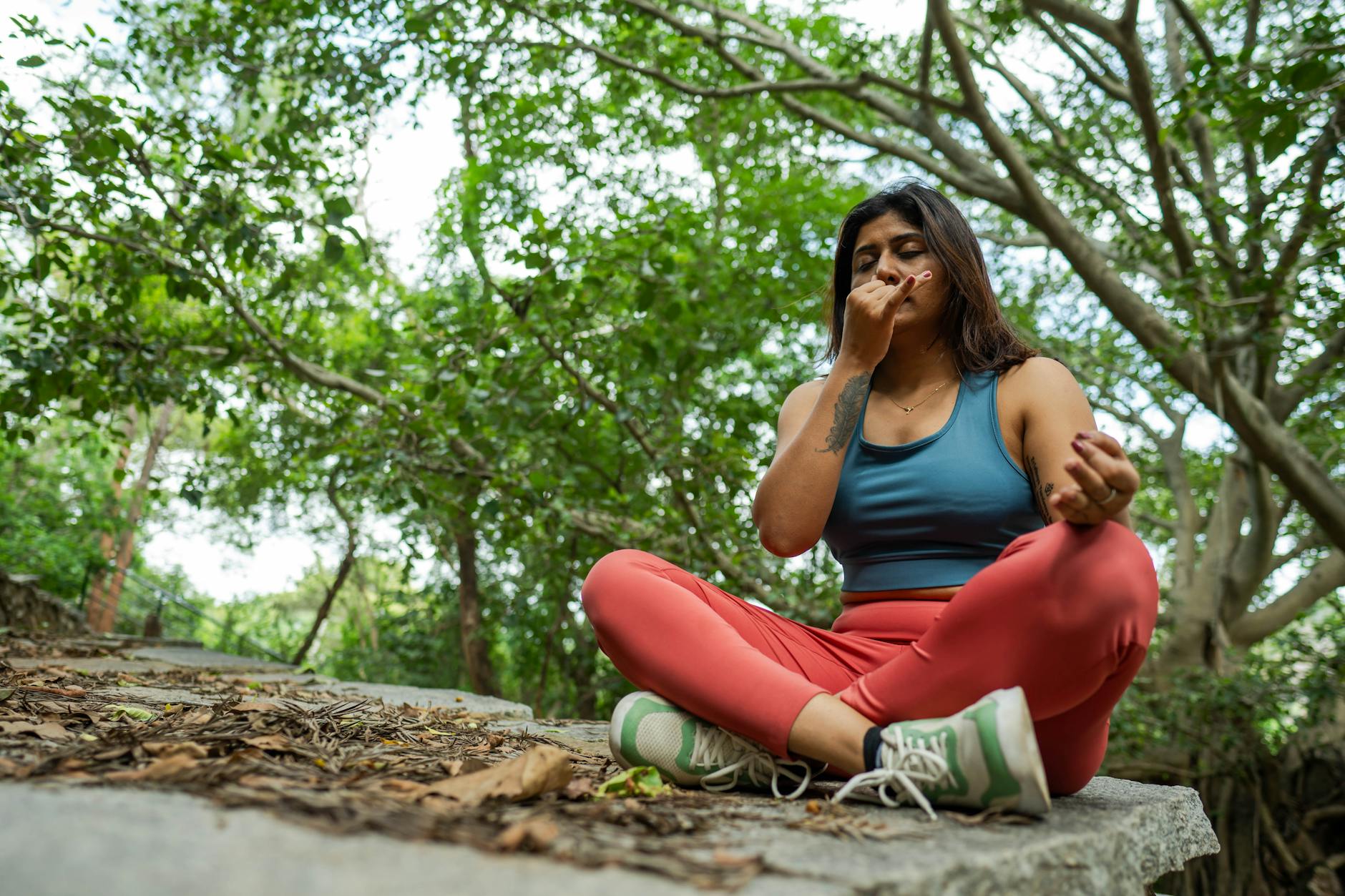
Breathing exercises may help some people feel less tense when they are anxious, mostly by settling the physical side: a pounding heart, a tight chest, and shallow, fast breathing. The research is encouraging but still limited, and the exercises work better for some people than others. Think of them as a small skill you can practice, not a treatment for an anxiety disorder.
Anxiety is partly something the body does. When you feel threatened or overwhelmed, breathing often becomes quicker and higher in the chest, and that can feel alarming in its own right. Slow, deliberate breathing gives you something to do with the body while the worry passes. This guide covers what the evidence says, four techniques worth learning, how to practice them, and when to stop or get help.
What the evidence says, and how far it goes
The US National Center for Complementary and Integrative Health (NCCIH), part of the National Institutes of Health, describes relaxation techniques such as breathing exercises as generally safe for healthy people. It notes that reviews have found preliminary support for diaphragmatic (belly) breathing in reducing stress, and that heart rate variability biofeedback, which often uses paced slow breathing, has been found helpful for self-reported stress and anxiety. It also reports that relaxation therapy reduced symptoms in people with several anxiety disorders in some studies.
Those findings come with limits. Many of the studies are small, they use different methods, and “breathing exercises” covers many different techniques. The explanations for why slow breathing helps, such as shifts in the body’s calming response, are still being studied, so it is more honest to say slow breathing is associated with calmer physical states than to claim a precise mechanism. And what works in a study group may not work for you on a given day.
The practical reading is simple. Slow breathing is low-cost and low-risk for most people, it is reasonable to try, and it is worth treating as one tool among several rather than a fix.
Four techniques worth learning
You do not need many. Pick one or two and practice when you are calm so they feel familiar when you are not.
Belly (diaphragmatic) breathing
This is the base skill. Sit or lie down with one hand on your belly and one on your chest. Breathe in slowly through your nose so the belly hand rises more than the chest hand, then breathe out slowly. Start with a few minutes. It can feel odd at first, especially if you usually breathe high in the chest.
Longer exhale breathing
Breathe in for a count of about 4 and out for 6. If counting to 6 leaves you short of air, shorten both counts. Comfort matters more than the numbers, and no particular ratio has been proven to be the best one.
Box breathing
Inhale for 4, hold for 4, exhale for 4, hold for 4. Many people like the structure because counting gives the mind a job. If the holds make you feel more anxious, drop them and breathe in for 4 and out for 4.
Paced slow breathing
This means roughly five to six breaths a minute, for example in for about 5 seconds and out for about 5 seconds, for several minutes. It is the pattern most associated with biofeedback research. You can do it with a plain timer.
| Technique | Pattern | Useful for | Watch for |
|---|---|---|---|
| Belly breathing | Slow, belly rises on the inhale | Building the habit | Feels unnatural at first |
| Longer exhale | In 4, out 6 | A quick reset | Feeling short of air |
| Box breathing | 4-4-4-4 | Focus under pressure | Holds can feel tense |
| Paced slow breathing | About 5 to 6 breaths a minute | Longer calm sessions | Needs several minutes |
How to practice so it is more likely to help
- Practice when you are calm. A few minutes once or twice a day is plenty. Trying a new pattern for the first time in the middle of a panic is hard.
- Keep it gentle. Smooth, quiet breaths are the aim. Forcing big, deep breaths can cause lightheadedness and tingling, which can feel like more anxiety.
- Do not chase a result. Treat each session as practice, not a test of whether you can make anxiety disappear.
- Attach it to something you already do. After brushing your teeth, before a meeting, at a red light. The guide on building a daily mindfulness practice shows how to make a small habit stick.
- Stop if it feels wrong. You are allowed to quit a session partway through.
For a tense moment, a short routine is enough: drop your shoulders, let out one slow sigh, then breathe in for 4 and out for 6 about six to ten times. Afterward, notice how your body feels rather than grading whether it “worked.”
When breathing exercises backfire
Some people find that focusing on the breath makes anxiety worse. If you tend to worry about body sensations, paying close attention to your breathing can feel like watching for a problem. NCCIH notes that relaxation techniques can occasionally bring on increased anxiety, intrusive thoughts, or a fear of losing control, and that there are rare reports of them causing or worsening symptoms in people with epilepsy, certain psychiatric conditions, or a history of abuse or trauma.
If breath practice is uncomfortable for you, that is common and it is fine to stop. Try another anchor instead, such as feeling your feet on the floor, naming five things you can see, or taking a slow walk. Mindfulness does not have to center on the breath, and the difference between mindfulness and meditation explains the other options.
A few more cautions:
- Breathing exercises address the body’s arousal. They do not address the causes behind an anxiety disorder, such as persistent worry patterns, trauma, or avoidance.
- Very fast or very deep breathing on purpose can cause dizziness and tingling. Stay slow and soft.
- If you have asthma, COPD, a heart condition, or are pregnant, ask your clinician before trying breath holds or long sessions.
- Relief that comes and goes is normal. One hard day does not mean the technique has stopped working.
Where breathing fits with other help
Breathing is one tool among several. The US National Institute of Mental Health lists relaxation exercises such as deep breathing and mindfulness among the ways people cope with stress and anxiety, alongside regular physical activity, steady sleep and eating routines, limiting caffeine, and leaning on supportive people. It also says that if you are struggling to cope or symptoms of stress or anxiety will not go away, you should seek professional support, and that treatment can include psychotherapy, medication, or both. A clinician can tell you which fits your situation.
Caffeine is worth a note because it can mimic anxiety. The US Food and Drug Administration says about 400 milligrams a day, roughly two to three 12-ounce cups of coffee, is not generally associated with negative effects for most healthy adults, and that people differ a lot in how sensitive they are. If you feel jittery or anxious well below that, cutting back may help.
If stress is the larger issue behind the anxiety, the piece on whether mindfulness can help with stress covers a complementary approach, and how to start meditating as a beginner offers a short seated practice.
When to talk to a professional
Anxiety is common and treatable, and you do not need to wait until it is severe. Consider talking to a doctor or mental health professional if:
- Anxiety is present most days for weeks and is hard to control.
- It interferes with work, school, sleep, relationships, or daily tasks.
- You avoid places or activities because of fear.
- You have repeated panic attacks, meaning sudden waves of intense fear with physical symptoms.
- You are relying on alcohol or other substances to cope.
Get urgent medical help or call your local emergency number if you have new or severe chest pain or pressure, trouble breathing that does not ease with rest, fainting, pain spreading to the arm or jaw, or sudden confusion or weakness. Panic attacks can feel just like these problems, and it is not safe to assume which one you are having, especially the first time.
If you are having thoughts of harming yourself, you do not have to handle it alone. In the US, call or text 988 to reach the 988 Suicide & Crisis Lifeline. Elsewhere, contact your local emergency number or a crisis line in your country.
To try a paced breathing pattern, use the guided breathing timer.
Where this comes from
This article is based on the National Center for Complementary and Integrative Health’s pages on relaxation techniques and on meditation and mindfulness, the National Institute of Mental Health’s fact sheet on coping with stress, and the US Food and Drug Administration’s consumer guidance on caffeine. It is general information, not medical advice. Guidance and figures can change, so check the current version at the source and talk to a qualified clinician about your own situation.