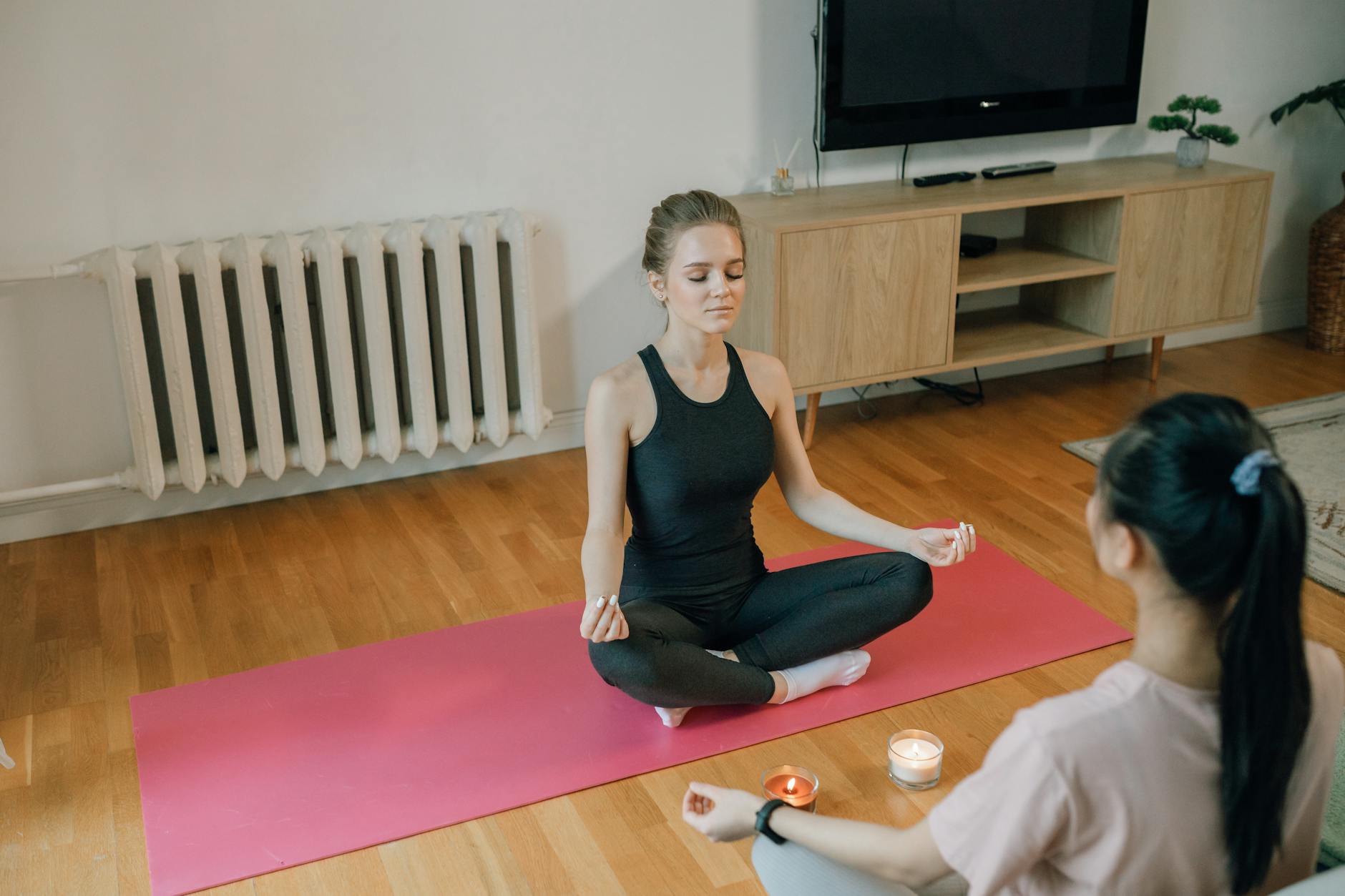
To start meditating, sit somewhere comfortable for about 5 minutes, close your eyes or soften your gaze, and pay attention to your breath. When your mind wanders, which it will, notice that and bring your attention back. That is the whole exercise. The returning is not a sign you are doing it wrong. It is the repetition that builds the skill.
Most beginners get stuck because they expect a blank mind, a special feeling, or fast results. Meditation is closer to training attention than to emptying your head. This guide covers what to do in your first sessions, how long to sit, what setup you need, what to expect, and how to keep going past the first week. It also covers the less-discussed side: meditation can be uncomfortable for some people, and that is a reason to adjust or stop, not to push through.
What meditation is, in plain terms
The US National Center for Complementary and Integrative Health (NCCIH) describes meditation as a variety of practices focused on mind and body integration, aimed at calming the mind. Some practices ask you to focus on something specific, such as the breath, a sound, an image, or a repeated word. Mindfulness meditation, the usual starting point, rests attention on something simple and notices, without judgment, when it drifts. Other styles include body scans, loving-kindness (directing kind wishes toward yourself and others), and walking meditation.
You do not need a belief system, a retreat, or equipment. If you are unsure how it relates to mindfulness in daily life, the article on the difference between mindfulness and meditation clears that up.
Your first session, step by step
Try this once today, before reading further.
- Set a timer for 5 minutes. Then you are not checking the clock.
- Sit comfortably. A chair with your feet flat on the floor is fine. Keep your back reasonably upright without stiffness, hands resting on your lap.
- Close your eyes or lower your gaze to a spot on the floor a few feet ahead.
- Take two or three slower breaths to settle, then let your breathing return to normal. Do not try to control it.
- Feel the breath where it is clearest. It might be the nostrils, the chest, or the belly. Stay with one in-breath, then one out-breath.
- When you notice you are thinking, label it softly (“thinking”) and return to the breath. Expect to do this many times in 5 minutes.
- When the timer ends, open your eyes slowly and take a moment before moving on.
If counting helps, count each exhale from one to ten, then start over. If you lose count, begin again at one without comment.
What a typical five minutes can look like
Here is an illustration, not a report of any particular person. You follow three breaths, then find yourself planning dinner. You notice, label it “thinking,” and return. Two breaths later you are replaying a conversation from yesterday. You notice again and return. By the end you may have returned to the breath a dozen times and strung together only a few breaths in a row. That still counts as a complete session, because the noticing and returning is the exercise.
How long and how often
Short and regular is easier to keep than long and rare.
| Stage | Length | Frequency |
|---|---|---|
| First week | 3 to 5 minutes | Daily if possible |
| Weeks 2 to 4 | 5 to 10 minutes | Most days |
| After a month | 10 to 20 minutes | Whatever you can keep up |
Formal courses often ask for much more, but they build up to it, and there is no single proven length for beginners. If five minutes feels like too much, try two. The point is a habit you can repeat, and the guide on building a daily mindfulness practice shows how to attach it to a routine such as morning coffee or brushing your teeth.
Setup: posture, place, and gear
You need less than the internet suggests.
- Posture: Sit in a chair, on a cushion, or on a bench. Lying down is fine too, but you may fall asleep, which usually just means you are tired. A good posture is stable, upright without strain, and relaxed in the shoulders and jaw.
- Place: A quiet corner works. Silence is not required, and everyday sounds can be part of the practice.
- Time: Morning suits many people and evening works as a wind-down. If you get drowsy, avoid sitting right after a large meal.
- Gear: None is required. A cushion is optional and a free timer on your phone is enough. Put the phone on do not disturb.
- Guidance: Guided recordings can help in the first weeks. Free ones are available through many libraries and community groups, and some apps have free tiers.
If sitting hurts, adjust. Pain in the back, knees, or hips is a signal to change position, not to push through.
If you fall asleep or keep missing days
Sleepiness is common, especially when you are short on sleep. Try sitting upright instead of lying down, keeping your eyes slightly open with a soft downward gaze, or moving the session to a time when you are more alert. If you are drowsy most of the time, sleep may be the thing to look at first.
Missed days are normal too. Do not try to make up for them with a longer session. Sit for your usual short time the next day. On a bad day, a single minute of following your breath keeps the habit alive.
What to expect, honestly
Expect your mind to wander constantly. Expect restlessness, boredom, itching, sleepiness, and a flood of to-do items. Those are normal content in early sessions. The skill being trained is noticing the drift and returning, and each return is one repetition.
Some people feel calm after a few sessions and others do not for a while. Some sessions feel worse before they feel better, because you suddenly notice how busy your mind is. Both are normal. NCCIH reports that mindfulness-based approaches have done better than no treatment for anxiety and depression in studies, and that they help people manage stress, but it also says the quality of the research varies and long-term effects are unclear. Benefits, where they show up, seem to come from regular practice over weeks and months, not a single session.
If you want to know more about what to do when your mind keeps drifting, read what to do when you cannot focus during meditation.
Common beginner mistakes
- Trying to stop thoughts. You cannot switch thoughts off. You can change how you relate to them.
- Judging each session. “Good” and “bad” sessions are mostly noise. Showing up is the measure.
- Straining. Clenching your jaw or forcing your attention creates tension. Use light effort.
- Going too long too soon. Starting with 30 minutes often leads to quitting. Build gradually.
- Switching methods constantly. Try one technique, such as breath awareness, for two to four weeks before deciding whether it suits you.
- Waiting for perfect conditions. A quiet house and a free hour rarely arrive. Five minutes beside a noisy street is real practice.
A simple four-week plan
This is an illustrative schedule, not a rule. Adjust it to your life.
- Week 1: 3 to 5 minutes of breath awareness at the same time each day.
- Week 2: 5 minutes, adding the count-to-ten method on busy days.
- Week 3: 7 to 10 minutes, trying one guided recording to see whether a voice helps.
- Week 4: 10 minutes, choosing whether to stay with breath awareness or try another style.
At the end of the month, ask what was easiest to keep doing, not what felt most impressive.
Other styles to try when you want variety
Once breath awareness feels familiar, you can try other approaches.
- Body scan: Move attention slowly from toes to head. It suits some people whose minds are busy.
- Loving-kindness: Silently repeat phrases like “may I be well” and extend them to others. Some people find this easier than breath focus.
- Walking meditation: Walk slowly for 5 to 10 minutes, feeling each step.
- Open awareness: Notice whatever arises, such as sounds, thoughts, and sensations, without choosing an anchor.
If breath focus makes you tense or anxious, use another anchor, such as sounds or the feeling of your hands. The piece on breathing exercises for anxiety covers when attention on breathing can backfire.
Safety and when to get support
NCCIH says meditation is usually considered to have few risks, while noting that research on harms is limited. It cites a 2020 review of 83 studies in which about 8 percent of participants had a negative effect, most often anxiety or depression, which is similar to the rate for psychological therapies. Some people, especially those with a history of trauma, severe depression, or psychosis, can find silent sitting distressing, with intense memories, panic, or a sense of unreality. Others just find it uncomfortable or boring. All of that is a legitimate reason to stop.
If that happens, shorten sessions, switch to eyes-open or movement-based practice, or work with a trauma-informed teacher or therapist. NCCIH also advises against using meditation to replace conventional care and suggests telling your health care providers about any complementary approaches you use.
See a doctor or mental health professional if low mood, anxiety, or stress lasts for weeks and affects your sleep, work, or relationships, or if meditation repeatedly leaves you more distressed instead of less. If you are having thoughts of harming yourself, seek help right away. In the US, call or text 988 to reach the 988 Suicide & Crisis Lifeline. Elsewhere, contact your local emergency number or a crisis line in your country. For sudden severe physical symptoms such as chest pain, fainting, or confusion, call your local emergency number.
To time your first sessions, use the meditation timer.
Where this comes from
This article is based on the National Center for Complementary and Integrative Health’s pages on meditation and mindfulness, covering what they are, effectiveness, and safety. The step-by-step session and the four-week plan are common beginner teaching formats offered as suggestions, not a clinical protocol. It is general information, not medical advice. Research and guidance change, so check the current version at the source and talk to a qualified clinician about your own situation.